


When you’re looking at a hot water service for a family home in Surrey Hills, the first thing to sort out is what your household actually needs. Below you’ll find the five Aussie hacks that can boost performance, cut waste, and keep the tap hot even during a Melbourne winter. I’ll walk you through local water quality, system choices, smart upgrades, and maintenance routines that work in our suburb’s mix of old brick bungalows and modern townhouses.
Get a Grip on Local Water Quality
Surrey Hills sits on a hard-water catchment, which means calcium and magnesium can build up inside tanks and coils. From what I’ve seen, a thin white film on the inside of a storage tank is a clear sign of scale. If you ignore it, you’ll lose up to 15 % efficiency over a few years. The good news is that a simple water-softening cartridge can be added to most hot water service setups without a major remodel.
- Check the water hardness level – a local council test kit will give you a reading in ppm.
- Install a magnetic or ion-exchange softener if the reading exceeds 150 ppm.
- Flush the system at least once a year to clear any sediment that settles at the bottom of the tank.
Pick the Right System for Surrey Hills Climate
Our climate swings from 12 °C winter mornings to 30 °C summer afternoons, so a one-size-fits-all heater rarely delivers the best results — In my experience, the most efficient choice depends on three factors: household size, roof space for solar, and whether you already have a PV array.
| System Type | Typical Recovery Time | Flow Rate (L/min) | Best For |
| Electric Storage Tank | 2–4 hours | 8–12 | Small homes, night-time electricity rates |
| Gas-Powered Tankless | Instant | 12–20 | Large families, high demand showers |
| Heat-Pump Heater | 1–2 hours | 10–15 | Eco-conscious owners, moderate roof space |
| Solar Hot Water (with backup) | Varies with sun | 8–14 | Homes with south-facing roof, strong PV |
What typically happens is that people stick with the old electric tank because it’s familiar, but a heat-pump can slash electricity use by up to 70 % in our temperate winters — And if you already have solar panels, a solar-assisted system can push that number even higher.
Hack 1 – Insulate Pipes and Tank for Immediate Savings
Insulation is the cheapest, fastest win you can make on any hot water service — A 25 mm foam wrap around the hot-water pipe from the tank to the furthest tap can keep heat loss under 5 % during winter nights — In my experience, a well-insulated tank also reduces the cycling of the heating element, extending its life.
- Buy a roll of pre-cut pipe insulation from Bunnings – it’s cheap and cuts the job in half.
- Seal any gaps around the tank with foil-backed tape to block drafts.
- Check the insulation integrity after a heavy rain; moisture can degrade the foam.
Hack 2 – Upgrade to a Smart Thermostat
Smart thermostats aren’t just for heating; they can control a hot water service too. By setting a lower standby temperature – say 55 °C instead of 60 °C – you shave off a noticeable chunk of energy without sacrificing comfort. You can program a “boost” for the morning rush, so the water is hot exactly when you need it.
- Choose a thermostat that integrates with Alexa or Google Home for voice control.
- Set a “vacation mode” that drops the temperature when the house is empty.
- Monitor usage through the app – you’ll see spikes & can adjust accordingly.
Hack 3 – Schedule Regular Maintenance with Local Plumbing Services
Even the toughest hot water service will falter without routine care — In Surrey Hills, most plumbers offer a 12-month service contract that includes a pressure-relief valve check, an anode rod inspection, and a brief system flush. From what I’ve seen, homeowners who skip this step end up with noisy tanks and premature failures.
- Ask for a visual inspection of the anode rod – replace it if it’s more than 50 % corroded.
- Check the pressure-relief valve for leaks; a drip can waste water & lower pressure.
- Schedule a thermostat water flush every 12 months to clear mineral buildup.
Hack 4 – Combine Solar Hot Water with Existing PV
Surrey Hills gets an average of 5.5 kWh/m² of solar irradiance per day which is perfect for a solar hot water system. If you already have a rooftop PV array you can add a solar-thermal collector without fighting for roof space — The result is a hot water service that runs on free sunlight for most of the year.
- Install a 2-panel solar collector on the north-facing roof – it’ll cover a 200-L tank comfortably.
- Use a controller that switches to electric backup when the sun isn’t shining.
- Monitor the system’s temperature rise via the built-in display; aim for a 45 °C boost on sunny days.
Hack 5 – Switch to a Heat-Pump Heater for Year-Round Efficiency
Heat-pump heaters pull heat from the air and transfer it to water, which means they use far less electricity than a standard element — In our mild winters, a heat-pump can keep the tank at 55 °C using only a fraction of the power — And because they’re quieter than a gas boiler, they’re a good fit for terraced houses where noise can travel through walls.
- Pick a model with a COP (coefficient of performance) of 3.5 or higher – that’s the efficiency rating.
- Make sure there’s at least 50 cm of clearance around the unit for airflow.
- Pair it with a smart thermostat to fine-tune the temperature and avoid overshooting.

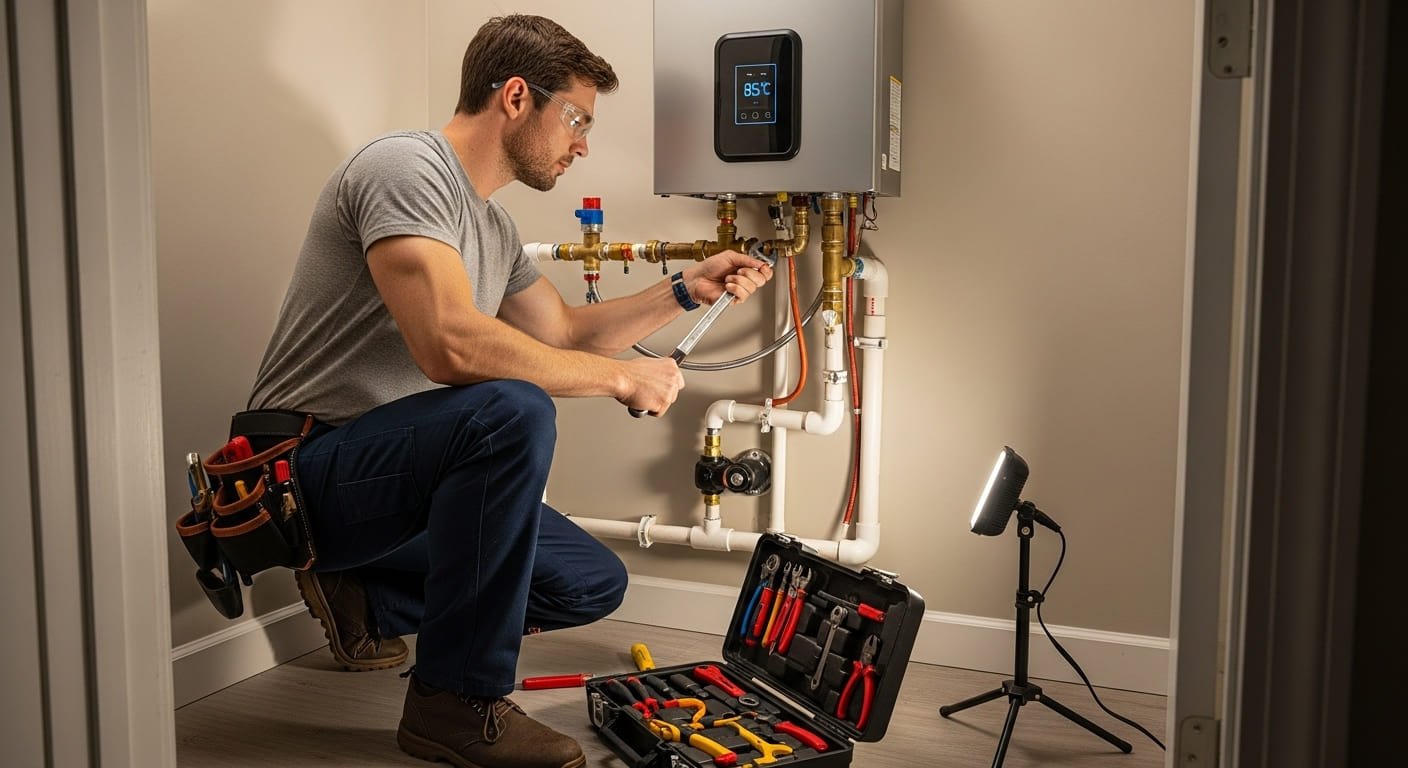
Hot Water Service
Case Study: The Bens from Surrey Hills
The Bens live in a three-bedroom bungalow on Canterbury Road. Their original electric storage tank was 12 years old, & they were dealing with lukewarm showers & a growing mineral deposit on the tank’s interior — After a quick inspection, a local plumber recommended three of the hacks above: pipe insulation, a smart thermostat, and a switch to a heat-pump heater.
First, they wrapped the 30 m run of hot-water pipe with 25 mm foam insulation. The plumber then installed a Wi-Fi-enabled thermostat set to 55 °C standby & programmed a morning boost at 06:30. Finally, they replaced the old tank with a 250-L heat-pump unit placed in the garage, using the existing electrical circuit.
Within a month, the Bens reported a noticeable rise in shower temperature and a 30 % drop in their electricity bill for hot water. The smart thermostat’s app showed a 45 % reduction in heating cycles, & the insulation cut pipe heat loss by roughly 6 % — Most importantly, the heat-pump ran quietly, and the Bens could finally enjoy a hot shower on a chilly June morning without waiting for the tank to recover.
Conclusion
Getting the most out of a hot water service in Surrey Hills isn’t about splurging on the newest gadget; it’s about matching the system to local conditions tightening up the weak points and using a few smart upgrades. From insulating pipes to adding a solar collector each hack brings a measurable improvement. Those steps with regular maintenance from a trusted local plumber, & you’ll keep the water hot the bills lower and the system reliable for years to come.