Professional Stump Removal Without Digging Up Your Lawn
We all love a good Australian backyard. Whether it is a perfectly manicured patch of Sir Walter Buffalo grass, a native garden, or a space for the kids to play cricket, our outdoor areas are an extension of our homes. But nothing ruins the flow of a garden quite like a tree stump. It sits there, an ugly reminder of the tree that used to be, getting in the way of the mower and tripping up anyone who isn’t looking.
For many homeowners, the thought of removing a stump brings up nightmares of excavators tearing up the turf, heavy machinery leaving tyre tracks in the mud, and a massive crater left behind that takes months to fix. Because of this fear, many people choose to simply ignore the stump. They place a pot plant on top of it or let the grass grow over it, hoping it will disappear.
The reality is that modern stump removal does not require destroying your garden. Advances in arboriculture technology mean we can now surgically remove a stump without digging a massive hole or bringing heavy earthmoving equipment onto your delicate lawn. It is a precise, efficient process that solves the problem while keeping your landscaping intact.
The Problem with Traditional Excavation
In the past, getting a stump out was a brute-force operation. You had two choices: spend a weekend breaking your back with a mattock and a shovel, or hire an excavator to rip the root ball out of the ground.
Excavation is messy. A tree’s root system is often much wider than its canopy. To pull a stump out physically, a machine has to dig wide and deep. This rips up significant sections of your lawn and disturbs the soil structure. Once the stump is out, you are left with a large void that needs to be filled with new soil and compacted before you can even think about laying turf again. For a suburban home in Sydney or Melbourne where space is tight, this method is often overkill and causes more damage than it solves.
The Solution: Precision Stump Grinding
The preferred method for professional stump removal in Australia today is stump grinding. This technique focuses on the stump itself, leaving the surrounding soil and grass undisturbed.
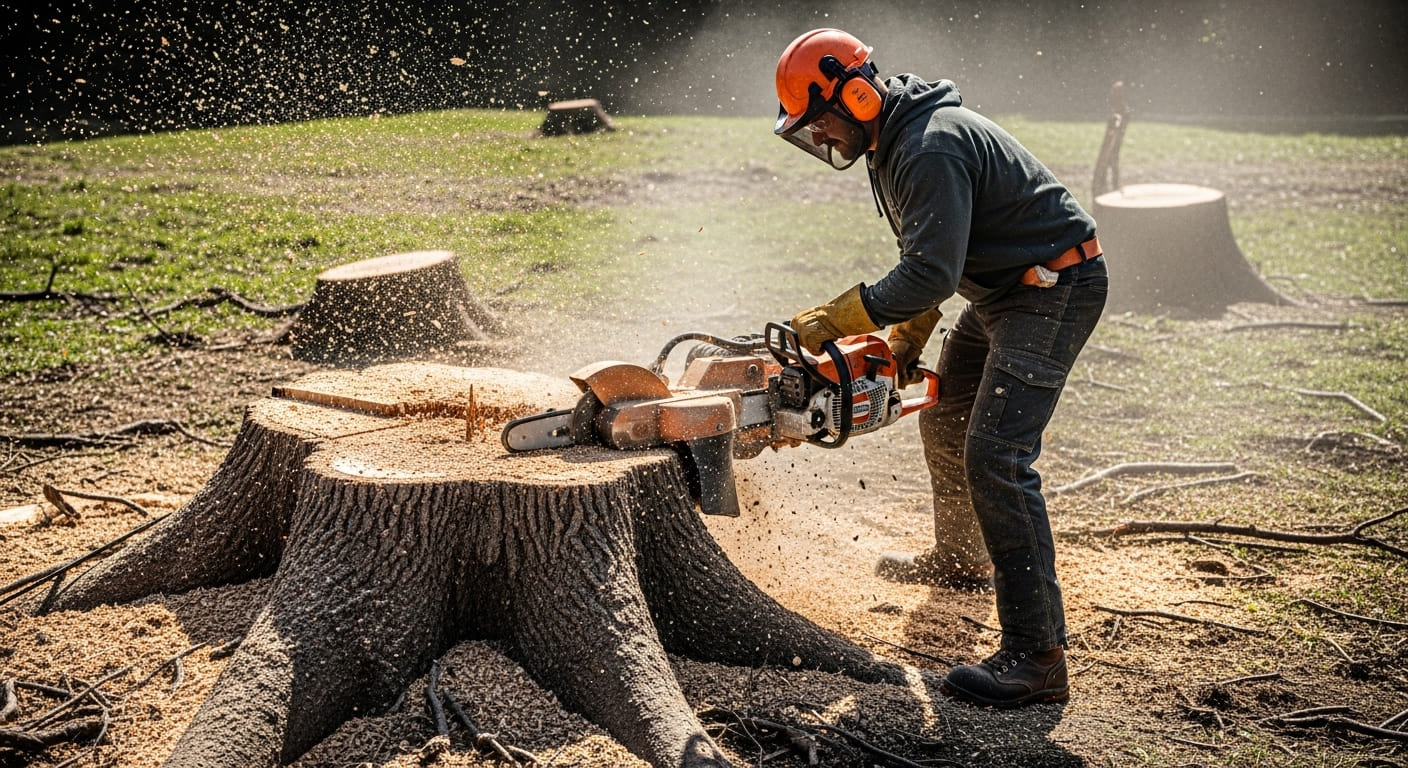
A stump grinder is a specialized machine equipped with a high-speed cutting wheel. This wheel is lined with industrial-grade tungsten teeth. The machine is positioned directly over the stump, and the operator uses hydraulic controls to sweep the cutter wheel back and forth across the wood.
Instead of pulling the roots out, the machine shaves the wood down into small chips. It grinds the stump from the top down, going well below the surface level. This effectively severs the trunk from the root system. Once the main stump is ground away, the remaining roots in the ground will die off and decompose naturally over time.
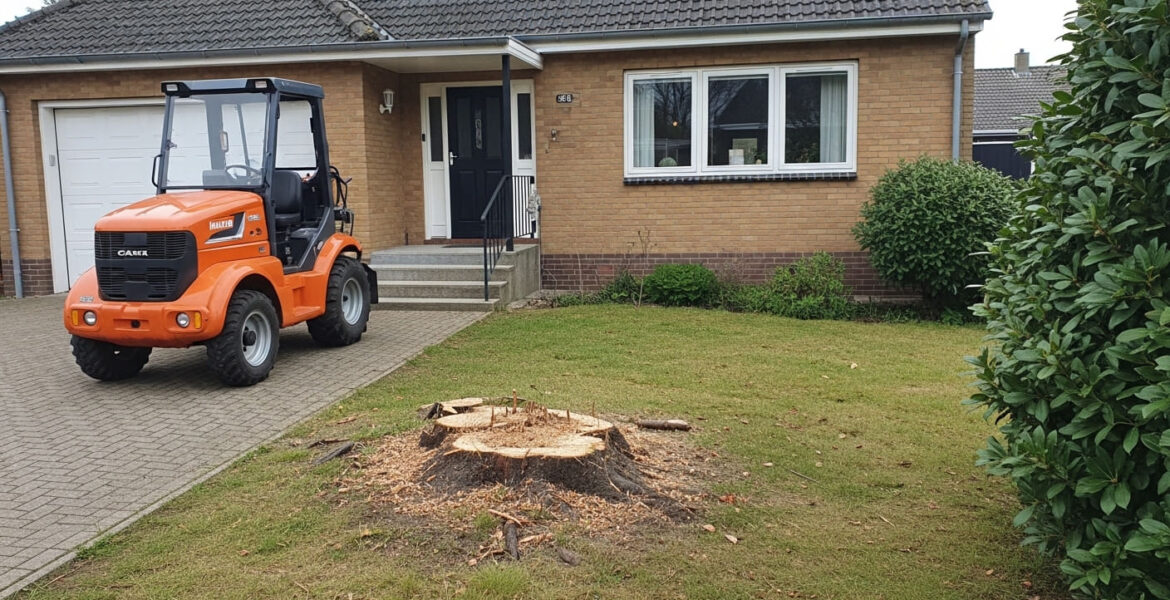
This method is incredibly low-impact. The machine usually rides on rubber tyres or tracks designed to distribute weight evenly, preventing damage to your lawn. You get the stump removed, and the rest of your garden looks exactly as it did before we arrived.
Why Leaving the Stump is a Risk
You might be thinking, “If I don’t want to dig it up, why not just leave it there?” It is a fair question, but in the Australian environment, a rotting stump is more than just an aesthetic issue. It attracts trouble.
The Termite Magnet
In Australia, we have a serious problem with termites, often called “white ants.” These pests are constantly on the lookout for cellulose—wood—to eat. A dying, rotting stump in your backyard is essentially a beacon for termite colonies. It provides them with food and moisture in a dark, protected environment.
Once a colony establishes itself in an old stump, they will eventually look for more food. If that stump is close to your home, deck, or fence, those structures are next on the menu. Professional stump removal eliminates this risk by removing the food source before the pests move in.
Safety and Liability
A stump cut low to the ground is a major tripping hazard. In long grass, it becomes invisible. If you have children running around, elderly relatives visiting, or even just guests over for a barbeque, a hidden stump is a broken ankle waiting to happen. Furthermore, hitting a hardwood stump with a lawnmower can shatter the mower blade, sending metal shards flying and ruining your equipment.
Unwanted Regrowth
Many Australian tree species are survivors. Trees like Willows, Poplars, and even some hardy Eucalypts can regenerate from a stump. You might cut the tree down, only to find vigorous shoots—called suckers—sprouting from the stump or the roots weeks later. These suckers grow fast and can turn into a bush that is harder to remove than the original tree. Grinding the stump kills the central growth point, preventing this resurrection.
Handling Australian Hardwoods
Not all stumps are created equal. In Europe or North America, many trees are softwoods. In Australia, we deal with some of the hardest timber in the world. Ironbark, Red Gum, and Box trees have wood that is dense and tough.
Attempting to remove these stumps with cheap rental equipment or hand tools is often a wasted effort. A small, underpowered grinder will bounce off an Ironbark stump, barely making a scratch while wearing out the operator.
Professional arborists use machines with high horsepower and heavy-duty teeth specifically designed to chew through Australian hardwood. Whether it is a fibrous Palm tree root ball that clogs up smaller machines or a rock-hard Gum stump, professional stump removal equipment is built to handle the local flora efficiently.
Access and Underground Services
One of the main concerns homeowners have is getting the machine to the stump. Many backyards in Australia are accessed via a narrow side gate or through a garage.
Modern equipment is designed with this in mind. At True Blue Trees, we utilize stump grinders that are slim enough to fit through a standard pedestrian gate. These compact machines pack a punch but are agile enough to navigate narrow paths, negotiate garden beds, and reach stumps in tight corners without trampling your flower beds.
Dial Before You Dig
Before any ground is broken, safety is the priority. Your front yard is often home to essential services like water pipes, gas lines, electricity cables, and NBN connections. Tree roots often grow around and under these pipes.
A professional operator will assess the site for signs of underground services. In Australia, we use the “Dial Before You Dig” service to locate assets. If a stump is sitting directly on top of a gas pipe, we can adjust our grinding depth or technique to ensure the wood is removed without causing a catastrophic leak. This level of care is something you rarely get with a DIY approach.
What Happens to the Mess?
The process of grinding a stump creates a significant amount of mulch. A solid stump turns into a pile of wood chips mixed with soil. This volume is always greater than the volume of the original stump because the wood has been aerated.
You have options for this material:
- Backfilling: Most commonly, the mulch is used to fill the hole left by the stump. Over a few weeks, this mound will settle and flatten out.
- Garden Mulch: Excess chips can be spread over other garden beds to retain moisture and suppress weeds.
- Removal: If you want a perfectly clean slate immediately, the excess mulch can be carted away.
Once the hole is filled, you can cover it with topsoil and sprinkle grass seeds or lay a patch of turf. Within a few months, you won’t even be able to tell where the tree used to be.
Stump removal
Questions and Answers: Common Questions About Stump Removal in Australia
Q: Will stump grinding damage my existing lawn?
A: No, that is the main benefit of this method. We use machines with specialized tyres or tracks that distribute weight to prevent ruts. We can also use ground protection mats if the ground is particularly soft or wet. The only area disturbed is the immediate footprint of the stump itself.
Q: How deep do you grind the stump?
A: Standard stump removal usually goes to a depth of about 150mm to 300mm below the ground surface. This is deep enough to kill the root system and allow for turf or small plants to be placed over the top. If you plan to build a structure or plant a large new tree in the exact same spot, let us know, and we can grind deeper to remove more of the root ball.
Q: Can I hire a machine and do it myself?
A: You can, but it is not recommended for most people. Rental machines are often small, underpowered, and poorly maintained. They can be dangerous to operate if you don’t have experience, especially with the risk of flying debris. Furthermore, grinding a large hardwood stump with a rental machine can take an entire day, whereas a pro can do it in an hour.
Q: What about the roots spreading out from the stump?
A: We typically focus on the main root ball (the “meat” of the stump). The lateral roots spreading out into the lawn are usually left in the ground. Once they are severed from the main stump, they will die and decompose naturally, adding nutrients back into the soil. If there are surface roots that are tripping hazards, these can be chased out and ground down as well.
Q: How much does stump removal cost?
A: The price varies depending on the size of the stump (diameter), the type of wood (hardwood vs. softwood), and the accessibility of the site. A stump in a front yard is cheaper to remove than one up a flight of stairs in the back. We provide free quotes to give you an accurate price before starting.
Conclusion: Your Path to a Successful Stump Removal in Australia
There is no need to let an old tree stump dictate how you use your garden. Nor do you need to fear that removing it will turn your backyard into a construction site. Modern stump removal techniques offer the perfect balance of power and precision. You get rid of the hazard and the eyesore without sacrificing your lawn.