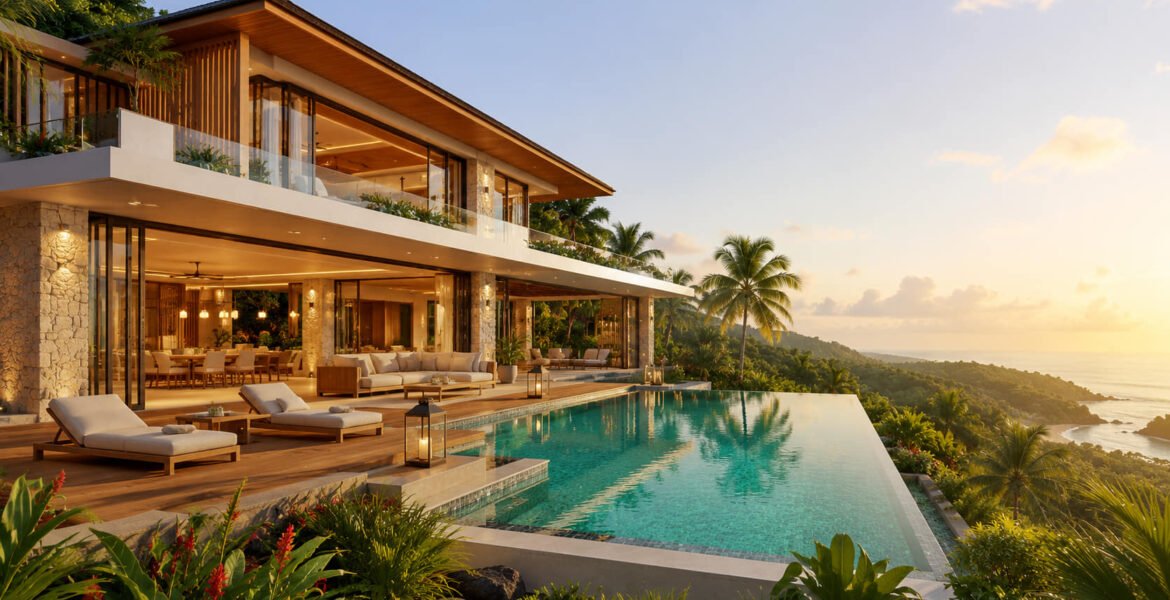
10 Low Cost Tropical House Design Ideas for the Far North

Up here, the sun doesn’t ask permission. It arrives early, stays late, and brings its humid mate along for the ride.
If you’re planning a build in North Queensland, you already know that low cost tropical house design isn’t just about finding the cheapest floor plan. It’s about designing a home that works with the climate – so you’re not spending every dollar you saved on construction running the air con 24/7 for the next 30 years.
The good news? Tropical architecture has centuries of built-in wisdom. And most of it is cheaper than the alternatives.
Why tropical house design is different (and cheaper if done right)
Most house designs sold in Australia were built for a southern climate. Four walls, a pitched roof, maybe a small deck. Slap it in Cairns and you’ve got a very expensive oven.
Good house design for a tropical climate flips the script. Instead of sealing the house and cooling it mechanically, you design it to shed heat naturally – through airflow, shade, and smart orientation. That’s passive cooling house design tropical architects have used for generations, and it works.
The financial case is simple. A well-designed tropical home can reduce air conditioning use by 50–70%, according to the Australian Government’s YourHome guide. Over a 20-year mortgage, that’s tens of thousands of dollars in energy costs – money that more than pays for the design features that made it possible.
Designing for the tropics also means designing for cyclone season. And here’s the counterintuitive bit: cyclone-resilient design features – hip roofs, simple footprints, strong connections – are often the same features that reduce build costs. Less complexity equals less cost equals less to lose in a Category 3.
10 low cost tropical house design ideas
1. Raise the floor – airflow under the house
Tropical House Design
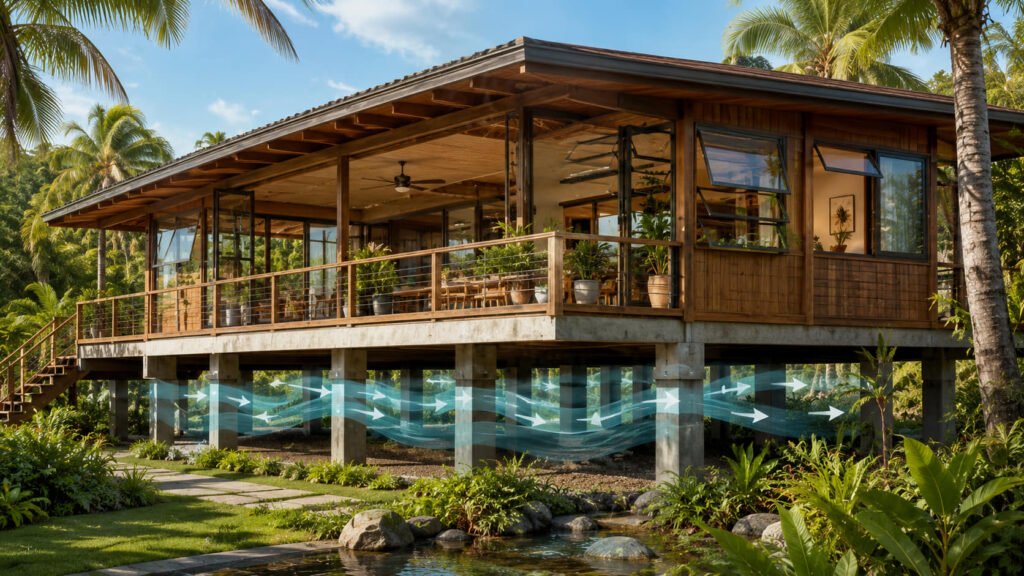
The Queenslander didn’t happen by accident. Raising a home off the ground on stumps or posts does three things at once: it catches the breeze underneath the floor, it keeps the interior cooler without a single kilowatt of electricity, and it protects against flooding – which, in North QLD, is not a theoretical concern.
Stumped or post-and-beam construction can actually be cheaper than a concrete slab in areas with reactive soils or flood overlays. And the airflow dividend lasts the life of the building.
Don’t overlook the practical upside either: under-house storage, parking, and laundry space come free with the territory.
2. Louvres over glass – cheaper and cooler
Tropical House Design
Glass is a heat trap. In a tropical climate, a large north-facing window is essentially a solar panel pointed directly at your living room.
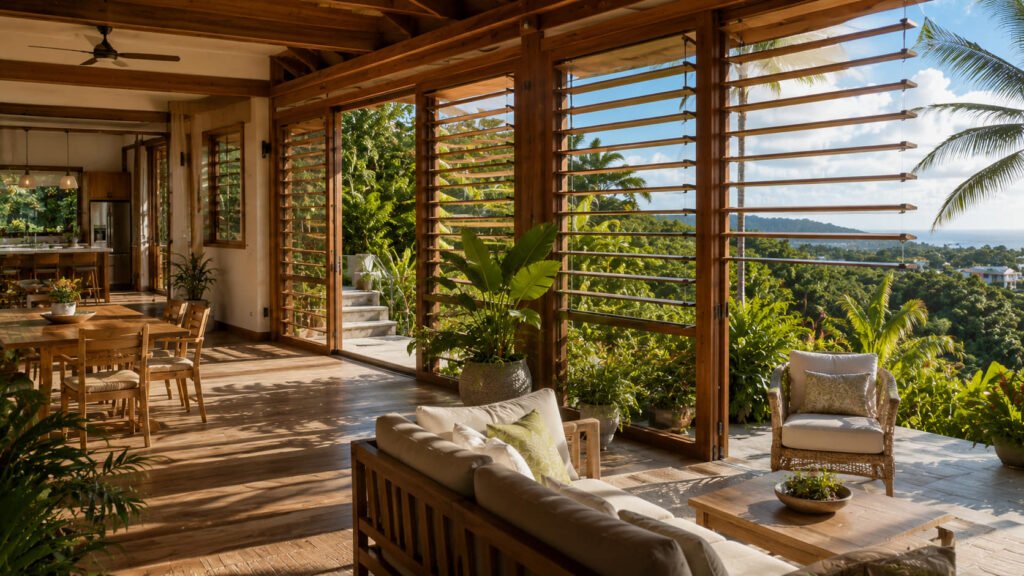
Louvred windows and walls are the smarter, cheaper alternative. They cost less than double-glazed glass, they can be angled to catch prevailing breezes, and they let air move through the house even when it’s raining – which, up here, is often.
Timber or aluminium louvres on the windward side of the house, combined with openings on the leeward side, create a natural cross-ventilation system that no split system can replicate for the same cost.
3. Wide verandahs as outdoor rooms
Tropical House Design
Here’s the thing about outdoor living Australia-wide: most of the country gets a few good months of it. North Queensland gets twelve.
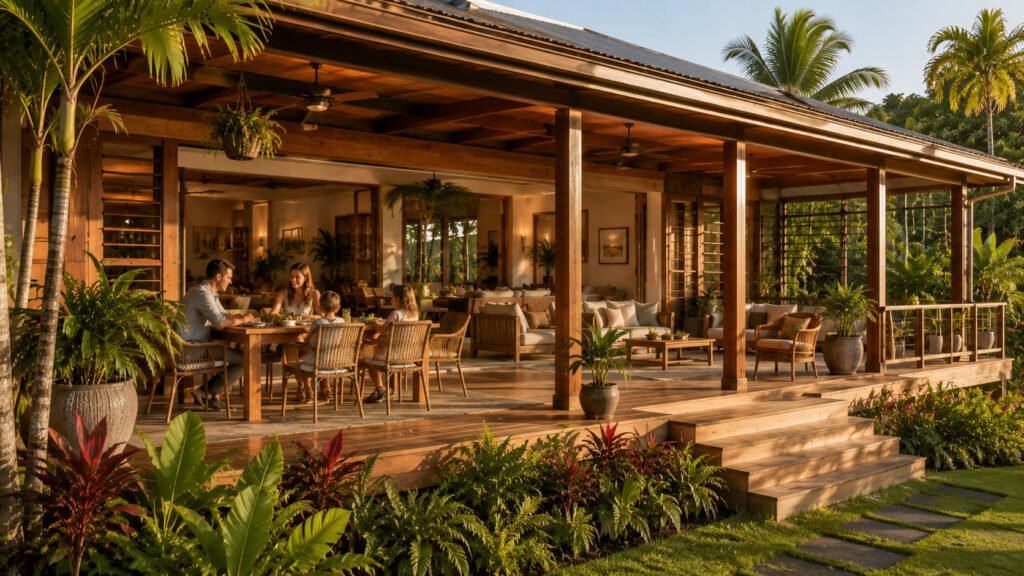
A wide verandah – minimum 2.4 metres deep, ideally 3.6 metres – is the single best dollar-per-square-metre investment in a tropical home. It shades the walls and windows from direct sun, extends your living space without the cost of an enclosed room, and creates the buffer zone between outside heat and inside cool that makes the whole house work.
Wrap it around two or three sides of the house and you’ve built a passive cooling system, an outdoor dining room, a kids’ play area, and a cyclone shelter all in one.
4. Simple rectangular footprint – less waste, less cost
Tropical House Design
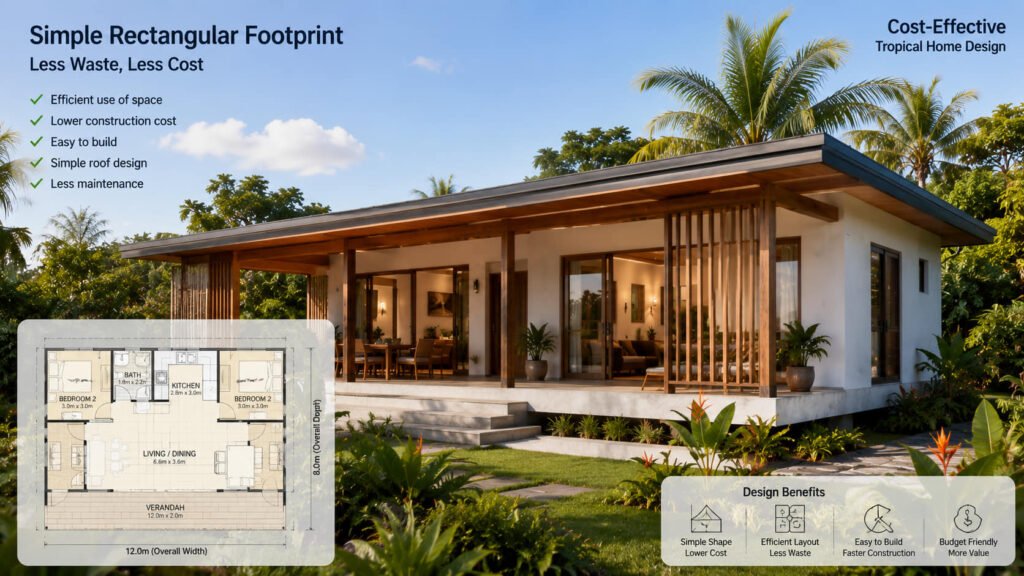
Every corner you add to a floor plan adds cost. More formwork, more framing, more roofing complexity, more potential leak points.
A simple rectangular or L-shaped footprint is the most cost-efficient shape you can build – and in a tropical climate, it’s also the most functional. It’s easier to ventilate, easier to shade, and easier to make cyclone-resilient.
Resist the temptation to add architectural interest through floor plan complexity. Add it through materials, verandah detailing, and landscaping instead. Your builder’s quote will thank you.
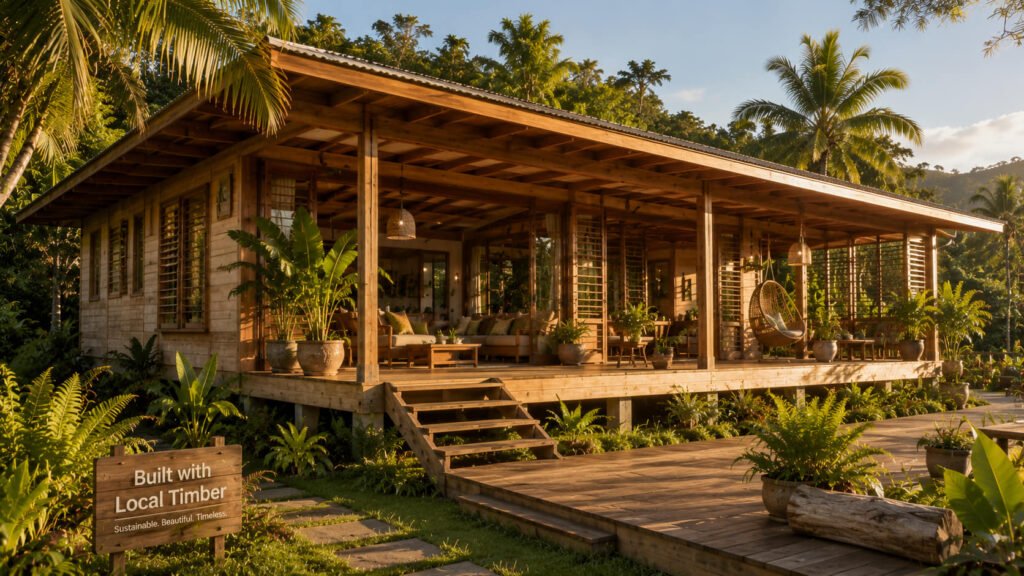
5. Local timber over imported materials
Tropical House Design
Imported hardwoods and engineered timbers have their place. That place is not a budget tropical build in Far North Queensland.
Local timbers – spotted gum, ironbark, cypress pine – are available, proven in the climate, and significantly cheaper than imported alternatives. They’ve been used in Queensland homes for over a century because they work: they’re dimensionally stable in humidity, naturally resistant to termites, and they don’t need to travel 10,000 kilometres to get to your site.
Talk to your local timber merchant before you talk to a national supplier. The price difference is often 20–40%.
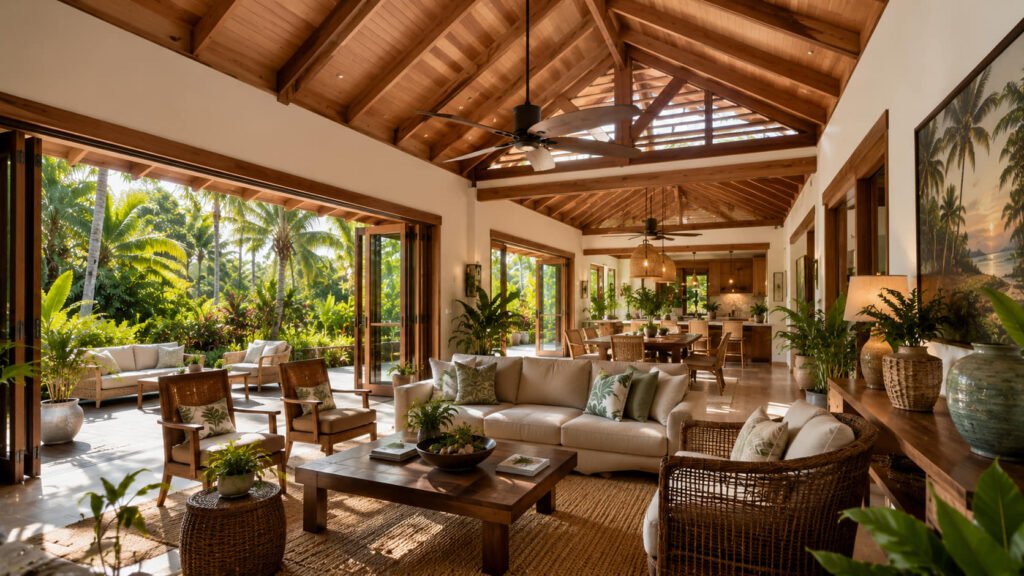
6. High ceilings with ceiling fans
Tropical House Design
A 2.4-metre ceiling is fine in Melbourne. In Cairns in February, it’s a low-grade punishment.
High ceilings – 2.7 metres minimum, 3 metres if you can manage it – allow hot air to rise away from the living zone. Combined with ceiling fans (which cost almost nothing to run compared to air conditioning), they create a comfortable living environment at a fraction of the energy cost.
The additional wall height adds some cost to the frame, but it’s modest – and the long-term comfort and energy savings make it one of the best value-per-dollar decisions in a tropical build.
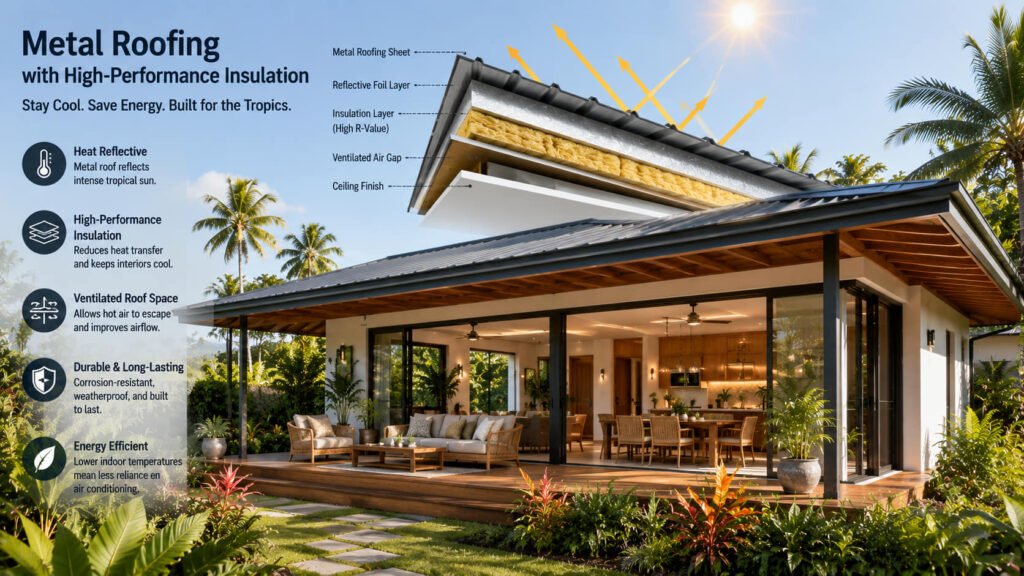
7. Metal roofing with good insulation
Tropical House Design
Colorbond and corrugated metal roofing are the default in North Queensland for good reason. They’re lightweight, cyclone-rated, low maintenance, and significantly cheaper than concrete tile – which adds dead load, requires a heavier frame, and can become airborne in high winds.
The catch with metal roofing is heat transfer. Without good insulation – bulk insulation in the ceiling cavity plus a reflective foil layer – a metal roof will radiate heat into the house all afternoon.
Get the insulation right and metal roofing is the best value option available. Skip it and you’ve built a very stylish oven.
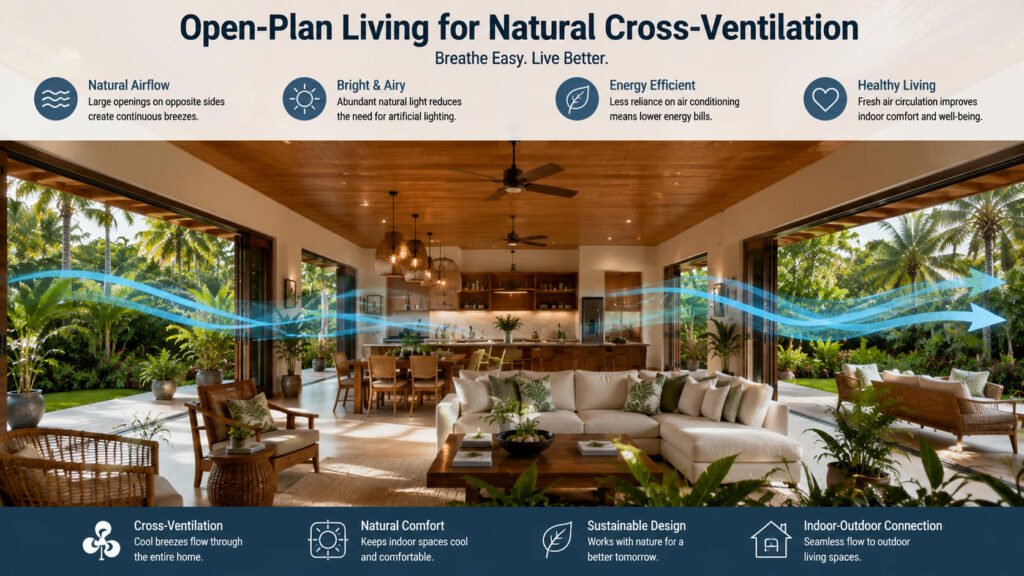
8. Open-plan living for natural cross-ventilation
Tropical House Design
Air needs a path through your house. Walls, doors, and corridors interrupt that path and force you to rely on mechanical cooling to compensate.
An open-plan living, dining, and kitchen layout removes the obstacles and lets the breeze do its job. Combined with louvred openings on the windward side and openable windows or doors on the leeward side, you create a natural airflow system that works around the clock.
Open-plan also reduces the number of internal walls you need to build – which, on a tight budget, is a genuine cost saving.
9. Tropical gardens as natural shade
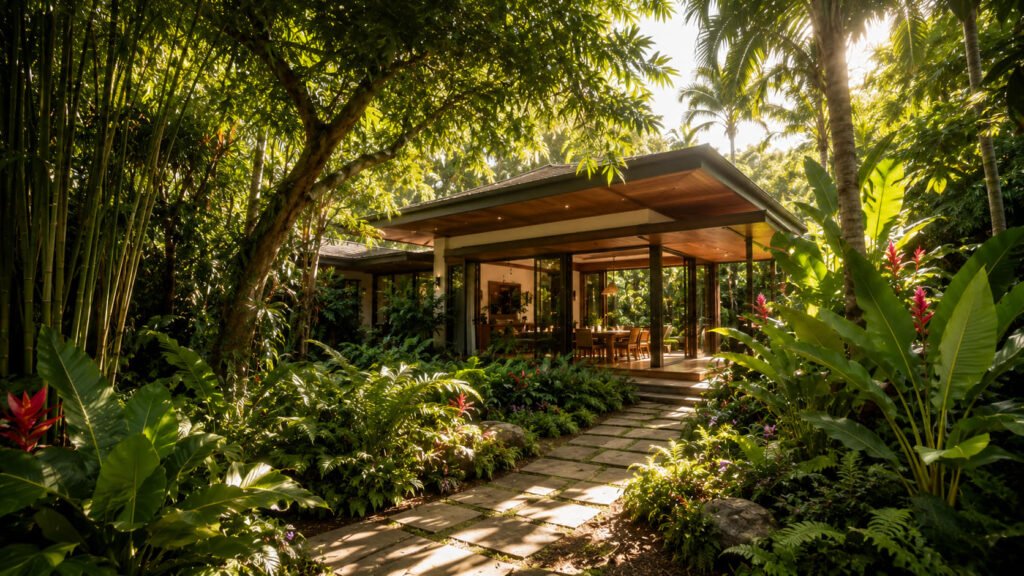
The most underrated passive cooling tool in a tropical build isn’t a design feature at all. It’s a tree.
Tropical House Design
Strategic planting on the east and west sides of the house blocks the low morning and afternoon sun – the angles that cause the most heat gain and that eaves and verandahs can’t easily shade. A mature mango tree on the western boundary can reduce afternoon wall temperatures by 10°C or more.
This is where tropical beach house design ideas diverge from their southern counterparts. Up here, the garden isn’t decoration – it’s infrastructure. Fast-growing local species like Leichhardt trees, Cooktown ironwood, and native palms establish quickly and cost almost nothing compared to the air conditioning they replace.
10. Cyclone-rated construction from the start
Here’s the one that people try to value-engineer out of the budget. Don’t.
Tropical House Design
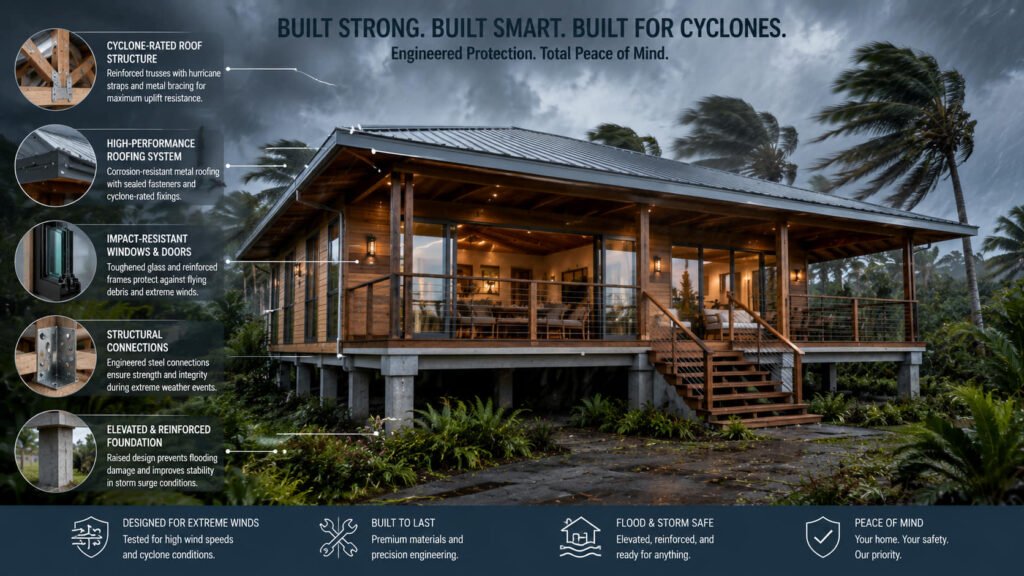
Cyclone proof home designs aren’t a luxury in North Queensland – they’re the baseline. Building to cyclone rating from the start adds roughly 5–10% to construction costs. Retrofitting cyclone connections, roof tie-downs, and impact-resistant glazing after the fact costs two to three times as much – and that’s before you factor in what an underbuilt home costs you in insurance premiums, storm damage, and sleep.
Hip roofs (which perform significantly better than gable ends in high winds), strong roof-to-wall connections, and cyclone-rated windows are the non-negotiables. Your certifier will require them anyway. Budget for them from day one.
What does a low cost tropical house actually cost in North QLD?
Build costs in Queensland vary significantly by location, specification, and contractor availability – but here are realistic 2024–2026 benchmarks to work with.
Standard residential construction in regional Queensland currently sits between $2,000 and $2,800 per m² for a project home or volume build. A custom tropical design with quality finishes runs $3,000–$4,500 per m², according to current data from the Queensland Building and Construction Commission (QBCC).
For a modest 120m² tropical home, that puts the build cost (excluding land, site works, and fees) at roughly:
| Build type | Cost range (120m²) |
|---|---|
| Kit home / owner-builder | $180,000 – $260,000 |
| Project home (volume builder) | $240,000 – $336,000 |
| Custom tropical design | $360,000 – $540,000 |
Kit homes are worth serious consideration in North QLD. Several suppliers offer cyclone-rated designs engineered specifically for the Far North – they arrive pre-engineered, reduce on-site labour time, and can be owner-built (with the right licences) to reduce costs further. They’re not glamorous, but a well-designed kit home in a tropical climate outperforms a poorly designed custom build every time.
Owner-builder is another cost-reduction path, but it comes with real obligations under Queensland law. Check the QBCC’s owner-builder requirements before going down that road.
The design principles behind every good tropical home
Strip back any successful modern tropical house design and you’ll find the same four principles underneath.
Orientation. The long axis of the house runs east–west, with the main living areas facing north. This maximises winter sun (on the rare days you want it) and minimises exposure to the brutal east and west sun angles.
Shade. Deep eaves, verandahs, and strategic planting shade walls and windows before the sun reaches them. Shading a wall is always cheaper than cooling the room behind it.
Ventilation. The house is designed to catch the prevailing breeze and move it through every room. Openings on the windward side, exits on the leeward side, and nothing in between to interrupt the flow.
Materials. Lightweight, locally sourced, and proven in the climate. Thermal mass (concrete, brick) works brilliantly in a temperate climate. In the tropics, it stores heat all day and releases it at night – exactly when you don’t want it.
Get these four right and you have the foundation of a home that’s comfortable, affordable to run, and built to last in one of Australia’s most demanding climates.
FAQ
What is the cheapest type of house to build in tropical Queensland?
A single-storey, rectangular kit home or project home built to cyclone rating is typically the most cost-effective option. Simple footprint, metal roofing, and a raised floor (which can reduce slab costs in some soil conditions) keep construction costs down. Expect to pay from around $180,000–$260,000 for a modest 120m² build using a kit home approach, excluding land and site costs.
Can you build a cyclone-rated home on a budget?
Yes – and you should. Cyclone-rated construction adds roughly 5–10% to build costs upfront. The alternative (retrofitting or repairing after storm damage) costs significantly more. Hip roofs, strong roof-to-wall connections, and cyclone-rated windows are the key features. Many kit home suppliers in North QLD offer cyclone-rated designs as standard.
What materials are best for low cost tropical homes?
Metal roofing (Colorbond or corrugated iron with good ceiling insulation), local hardwood timber, louvred windows, and fibre cement or timber cladding are the proven low-cost combination for North QLD. Avoid imported hardwoods, concrete tiles, and high-thermal-mass materials like brick or rammed earth – they work against you in a tropical climate.
How does passive cooling save money in North QLD?
A well-designed passive cooling system – cross-ventilation, high ceilings, shaded walls, raised floors – can reduce air conditioning use by 50–70%. On a typical North QLD home running ducted air con, that’s a saving of $1,500–$3,000 per year in electricity costs. Over a 20-year mortgage, the saving easily exceeds $30,000–$60,000 – far more than the design features cost to build in the first place.
Useful sources
- YourHome – Passive Design for Tropical Climates – Australian Government guide to climate-responsive design, including detailed tropical zone guidance.
- Queensland Building and Construction Commission (QBCC) – Licensing, owner-builder requirements, and building standards for Queensland.
- NatHERS – Nationwide House Energy Rating Scheme – Australia’s energy efficiency rating tool for residential buildings.
- Bureau of Meteorology – Climate Data for North Queensland – Prevailing wind directions, rainfall data, and cyclone history for your specific location.