Best generator for home backup power: how to pick size, fuel, and noise level
So, after a few failed attempts with under‑powered models, I finally found the sweet spot between capacity, fuel type, and sound level. And I’m here to share what I learned, hoping you won’t have to repeat my trial‑and‑error marathon.
How to Choose the Best Generator for Home Backup Power
Sizing It Right
First, make a list. You might need a fridge (about 700 W), a few lights (150 W total), and maybe a sump pump (1,200 W). Add a safety margin—about 20 % extra—so the generator isn’t constantly at its limit.
When I first tried a 3,000 W unit in my Brisbane home, the lights stayed on but the fridge kept cycling off during a storm. The culprit was the surge from the compressor. A fridge’s compressor can demand twice its running wattage for a few seconds. So pick a generator that can handle that spike.
Here’s a quick step‑by‑step you can follow:
- Write down every appliance you want to keep alive during an outage.
- Look up the nameplate wattage on each device—usually on a sticker or in the manual.
- Separate “running” watts from “starting” watts. Starting watts are often listed as “surge” or “peak”.
- Sum the running watts, then add the highest starting watt value you found.
- Multiply the total by 1.2 to give yourself a comfortable cushion.
For example, a typical family setup in Melbourne might look like this:
- Refrigerator: 700 W running, 1,400 W starting
- Freezer: 500 W running, 1,000 W starting
- LED lighting (10 bulbs): 150 W running
- Sump pump: 1,200 W running, 2,400 W starting
- Medical equipment (CPAP): 80 W running
Running total = 2,630 W. Highest start = 2,400 W. After the 20 % buffer, you’d look for a generator rated around 5,000 W.
Picking the Fuel Type
Fuel choices feel like a menu at a café—each has pros and cons. Gasoline is cheap and widely available, but it stores poorly and can go stale after a few months. Diesel runs longer and is more efficient, yet it’s heavier and pricier.
Because Australia’s rural areas often have better diesel supply, many homeowners opt for a diesel‑powered standby generator. In the Riverina region where I grew up, the local service station kept diesel on tap 24/7, while gasoline deliveries were sporadic.
If you live in a city like Sydney and want something you can move around, a gasoline model might be more convenient. I once borrowed a 4,000 W gasoline unit from a neighbour during a bushfire‑induced blackout; the whole thing weighed about 70 kg and fit in the back of a small van.
Here are a few practical points to weigh:
- Storage life: Gasoline starts to degrade after about three months unless you add a stabiliser. Diesel can sit for a year with minimal loss.
- Cost per litre (2024 figures): Gasoline averages $1.70 L, diesel $1.55 L in most Aussie suburbs. The difference adds up when you run the generator for many hours.
- Refill logistics: A 20‑litre gasoline tank gives you roughly 10 hours at half load, while a 30‑litre diesel tank can stretch to 15 hours.
- Noise and vibration: Diesel engines tend to vibrate more, which can be a concern if the generator sits close to a bedroom.
My own decision boiled down to a hybrid approach: a small gasoline portable for emergencies on the weekend, and a larger diesel standby that runs automatically when the grid drops out.
Noise Level Matters
Some models include sound‑proof enclosures that add a few kilograms but cut noise by 10‑15 dB. It’s like swapping a hand‑sewn quilt for a ready‑made duvet—more comfort, a little extra weight.
When I first installed a 6,000 W diesel unit in my Adelaide home, the enclosure pushed the weight up to 350 kg. The neighbour next door complained about a constant hum that sounded like a distant highway. I upgraded to a model with a factory‑fitted acoustic box, and the decibel reading dropped from 78 dB to 62 dB at a 3‑metre distance.
Local council rules can be strict. In many Australian suburbs, the limit is 70 dB after 7 pm. A quieter unit keeps you out of trouble and preserves goodwill with the HOA.
Tips to keep the sound down:
- Place the generator on a rubber mat to dampen vibrations.
- Use a muffler or an aftermarket silencer if the model allows it.
- Position the unit behind a solid fence or a wooden shed with a vented door.
- Run the generator at 50 % load whenever possible; lower loads produce less noise.
In my experience, a well‑ventilated metal shed with a double‑door design reduced perceived noise by another 3‑4 dB, making the night feel almost silent.
Best Generator for Home Backup Power
Practical Tips for Buying
When you walk into a hardware store, keep these three things in mind.
- Check the warranty—strong> most reputable brands offer at least three years. I bought a Honda 5,000 W unit in 2022; the 3‑year warranty saved me $200 when a spark plug needed replacement.
- Ask about service contracts; a local dealer can save you a trip to the city. In Perth, my supplier offered a $150 annual service that included a filter change and a free fuel‑stability test.
- Verify the voltage output matches your home’s 240 V standard. Plugging a 120 V‑only generator into a 240 V system can fry the inverter and your appliances.
Installation Considerations
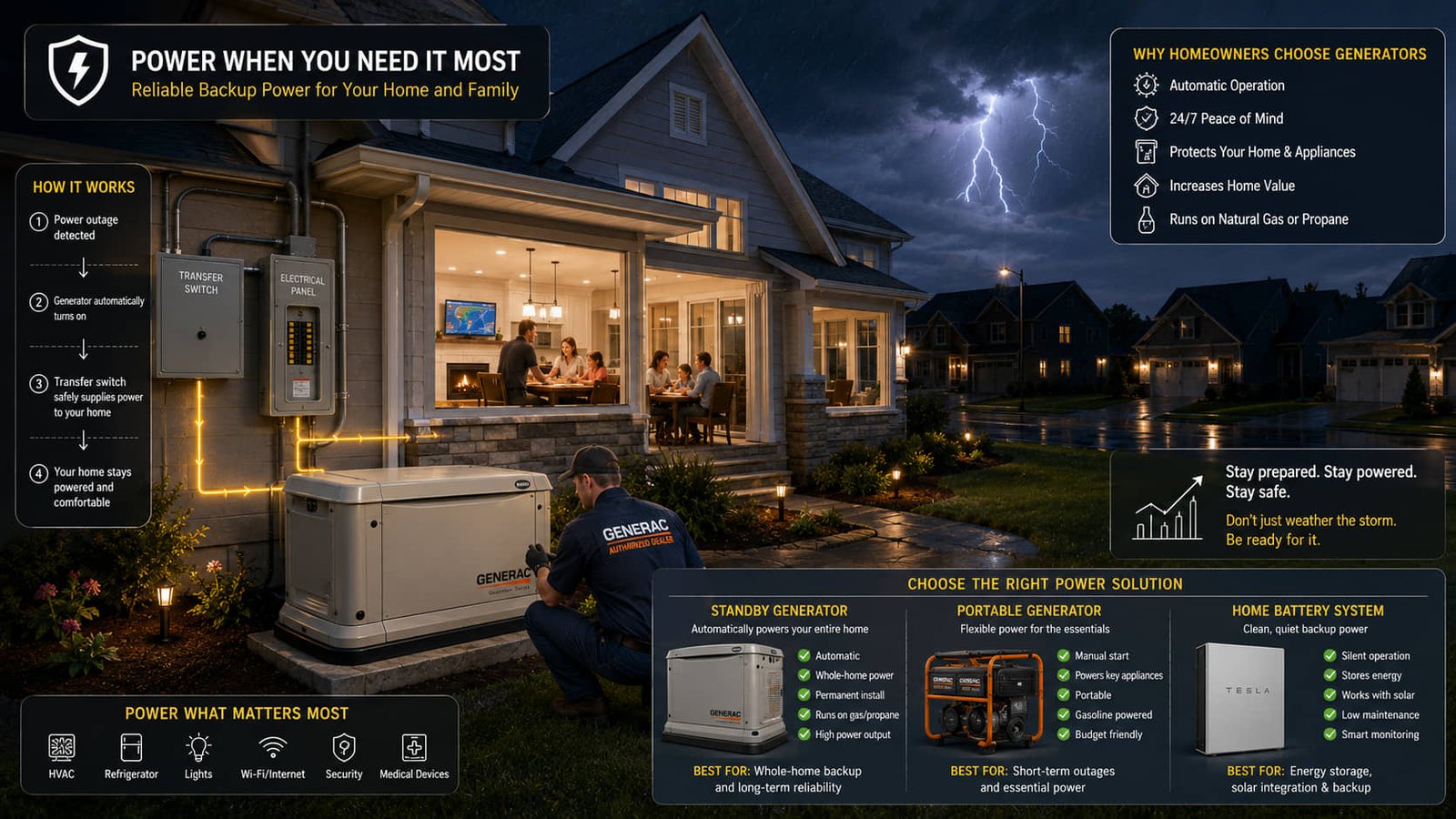
Installation is where the rubber meets the road. A permanent standby generator needs a transfer switch, which automatically shifts the load when the grid fails. This prevents back‑feeding, which can be dangerous for utility workers.
When I had my diesel standby installed in a Hobart suburb, the electrician ran a 30‑amp double‑pole transfer switch and labeled each circuit. The whole job cost about $1,200, but the peace of mind was priceless during the 2023 floods.
For portable units, you’ll need a proper extension cord—at least 12‑gauge for up to 2,000 W. Using a thin cord can cause voltage drop and overheating. I once used a 16‑gauge cord for a 1,800 W load; the cord hissed and the breaker tripped twice in an hour.
Because Melbourne’s climate can swing from hot summers to cool winters, place the generator in a well‑ventilated area, away from windows. A simple metal shed with a vented door does the trick. I built a 2 × 2 m shed using reclaimed timber; the cost was under $400, and the airflow kept the engine from overheating even on a 42 °C day.
Don’t forget clearance. Most manufacturers require at least 1 metre of space on all sides for airflow and easy maintenance. If you live in a cramped backyard, a raised platform can give you the needed clearance without sacrificing square footage.
Budget and Cost
Price Tags vary wildly. A basic 5,000 W gasoline generator might cost around $1,200, while a diesel standby unit with a transfer switch can run $4,500 or more.
But don’t just chase the lowest price. Think of it as an investment—like buying a good pair of boots that last years versus cheap shoes that wear out quickly. My first cheap gasoline unit lasted only 18 months before the carburetor clogged; I ended up spending $300 on a replacement and $150 on a new unit.
Here’s a rough breakdown of typical expenses in 2024 Australian dollars:
- Portable gasoline generator (5 kW): $1,200 – $1,800
- Diesel standby generator (7 kW): $3,800 – $5,200
- Automatic transfer switch: $600 – $1,200
- Installation labor (electrician + site prep): $800 – $1,500
- Sound‑proof enclosure (optional): $300 – $700
If you factor in fuel, a 20‑litre gasoline tank at $1.70 L gives you about 10 hours at half load, costing roughly $34 per run. A 30‑litre diesel tank at $1.55 L can run 15 hours for about $70. Over a year of occasional use, the fuel cost difference adds up.
Final Thoughts
Choosing the best generator for home backup power isn’t just about picking the biggest engine you can find. It’s a balance of size, fuel, and noise, all tailored to your lifestyle and local regulations. And if you take the time to match the unit to your needs, you’ll avoid the frustration of a powerless night.
When I finally got the right setup—a 6,000 W diesel standby with a transfer switch, a sound‑proof box, and a 30‑litre fuel tank—I slept sound during the 2024 bushfire season. The lights stayed on, the fridge kept humming, and the neighbours complimented the quiet operation.
So, what’s your biggest worry when the lights go out? Have you already scoped out a model that fits your budget and noise tolerance? Let’s keep the conversation going—what’s the one feature you can’t live without in a backup generator?